Note
Be Wrong on Purpose
Three of the four things a person knows cannot be asked for. Software asks anyway, then reads the silence as emptiness. The fix is not a better question. It is a wrong answer, said out loud.
Ask a restaurant owner what makes his place different.
"Good food, good service."
He is not being cagey. He is not guarding a secret. He has run that kitchen for eleven years and he can tell you, from the next room, which of his cooks is on the dum by the smell coming off the pot. The knowledge is in there. Your question could not reach it.
Now try it the other way. Put something in front of him. An ad for his own restaurant that reads: Authentic Hyderabadi biryani, made with love. Two hearts at the end.
He will answer in under a second, and he will be exact. No hearts. Never write "authentic." And the biryani sits sealed for forty minutes, we don't rush it, that's the thing, say that.
Six words in you have his voice, his forbidden words, and his real differentiator. You asked nothing. The only thing you did was be wrong in front of him.
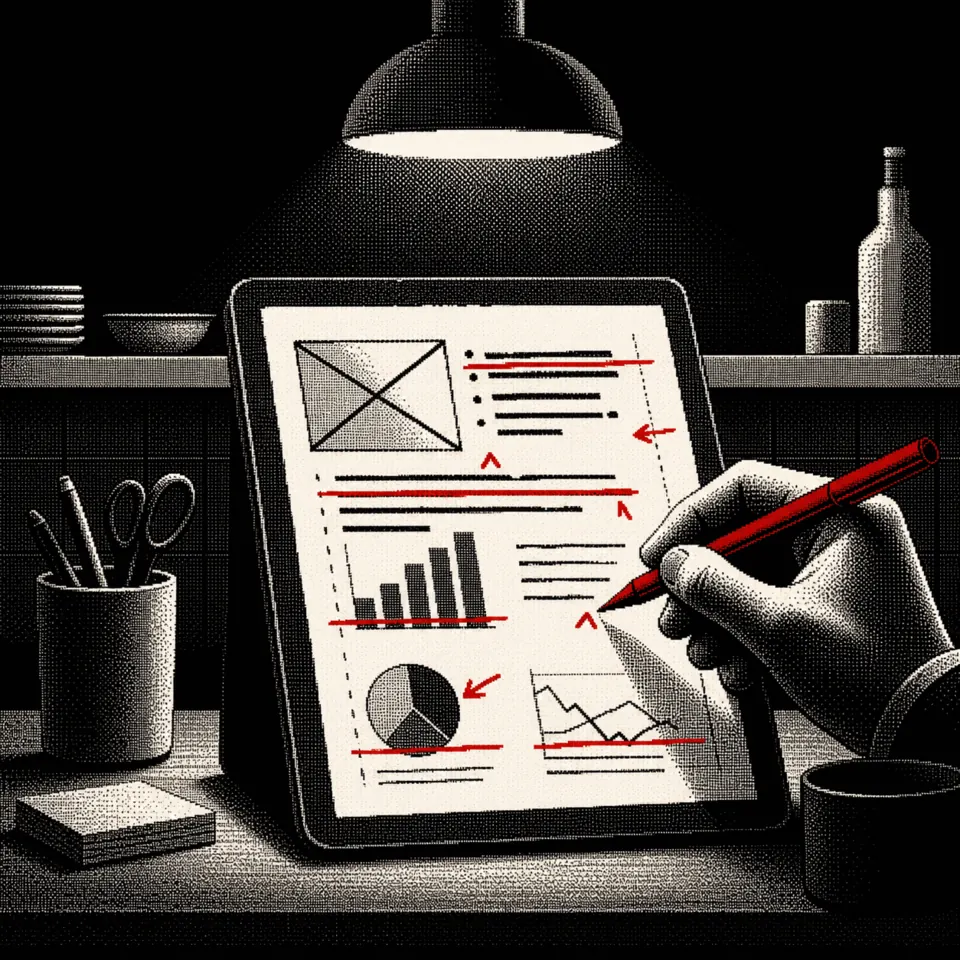
Four things a person knows
Rumsfeld gave us three of these at a Pentagon briefing in 2002 and got laughed at for it, which was unfair. He did not invent the taxonomy, aerospace and project management people had been using it for years, but there was nothing wrong with it. Known knowns. Known unknowns. Unknown unknowns.
Žižek went after the cell Rumsfeld skipped: the unknown known, the thing you know and do not know you know. He glossed it, being Žižek, as the Freudian unconscious, and he meant the beliefs a person disavows. Knowledge management later borrowed the same empty cell for something plainer, and the plainer one is what I want here. So I will take the cell and leave him his meaning.
Drawn as a taxonomy of facts, this grid is a party trick. It tells you the categories exist. It does not tell you to do anything.
Redraw it as a taxonomy of how a fact can be reached and every cell hands you a verb, a price, and a way to fail.
Known known. Ask. He knows it and can say it on demand. Address, hours, whether the kitchen does halal. Costs one question. This is the only cell a form can reach.
Known unknown. Listen. He knows the gap is there and cannot close it. What should I post? Why is the place across the road above me on the map? Free, if you are listening. It is a need, not a fact, and filing it as a fact poisons everything downstream.
Unknown known. Provoke. He holds it in his hands and cannot put it in words. His voice. His real differentiator. The constraint that makes your whole plan wrong. Don't push Friday, Friday is already full. Unreachable by question. Recoverable in one second by a bad draft.
Unknown unknown. Observe. He has never considered it, so the question does not exist for him to answer. His listing says he closes at ten and the kitchen shuts at nine thirty, and the gap has been quietly manufacturing one star reviews since April. Costs him nothing. Costs you money. You go and get it from the world.
One of those four verbs is a question.
Every form, every onboarding wizard, every setup flow, every chatbot with a friendly first message is built almost entirely out of that one verb. And it is the cheapest cell on the board.
The blank box
Every tool built for a small business owner inverts the labor.
It hands him the blank box, which is the expensive half, and keeps the publish button, which is the cheap half. Then it calls the blank box empowerment.
Look at what the two halves actually cost. Reacting to something costs one word. Producing something costs everything you know, arranged, in sentences, on demand, in a text field, while the lunch rush is starting. The blank box is not neutral and it is not a courtesy. It is a bill, and it is handed to the person least able to pay it.
The owner is not the bottleneck here. The interface is. He answered your question honestly and your question was bad.
Silence gets read as emptiness
Here is the failure that follows, and it is the one that made me want to write this down, because it is invisible from the inside and it is everywhere.
A system asks a good question. It gets nothing. It rephrases and asks again from another angle. Still nothing. So it concludes, sensibly, that there is nothing there, marks the topic covered, and moves on. Every well built system does some version of this, because otherwise it would ask forever.
For a known known, that rule is correct. He would have answered. He knows it.
For an unknown known, that rule is exactly backwards. Two failed questions are not evidence of absence. They are the diagnostic signature of the quadrant. He cannot answer, he will never be able to answer, no matter how the question is phrased, and the system has just read his inability as his emptiness and closed the file.
That is where a person's voice goes to die. That is where the constraint that would have stopped you from doing something stupid gets lost. The system asked, twice, in good faith, got silence, and wrote down: no distinguishing characteristics. Then it reports the profile as complete.
Silence is not a dead end. It is a routing signal. It tells you which verb to use next.
Recognition, not recall
The reason a bad draft works is not a trick of persuasion. It is a fact about memory.
Recall is the hard operation. Produce a thing from nothing, unprompted, correctly. Recognition is the easy one. Look at a thing and know instantly whether it is right. It is why multiple choice is easier than the essay, why you cannot name the song and know it in two notes, why "recognition rather than recall" has sat in Nielsen's usability heuristics since 1994.
The capacity difference is almost silly. In 1973 Lionel Standing showed people ten thousand photographs and they later picked them out of pairs at better than eighty percent. Nobody alive can describe ten thousand photographs. Recognition has room in it that recall does not.
Polanyi had already said the human version in 1966, opening The Tacit Dimension by proposing to reconsider knowledge "starting from the fact that we can know more than we can tell." Riding a bicycle, recognizing a face, running a kitchen. Not secret. Not deep. Just held somewhere the sentence-making part of a person cannot reach.
So the entire move is this. Convert a recall task into a recognition task.
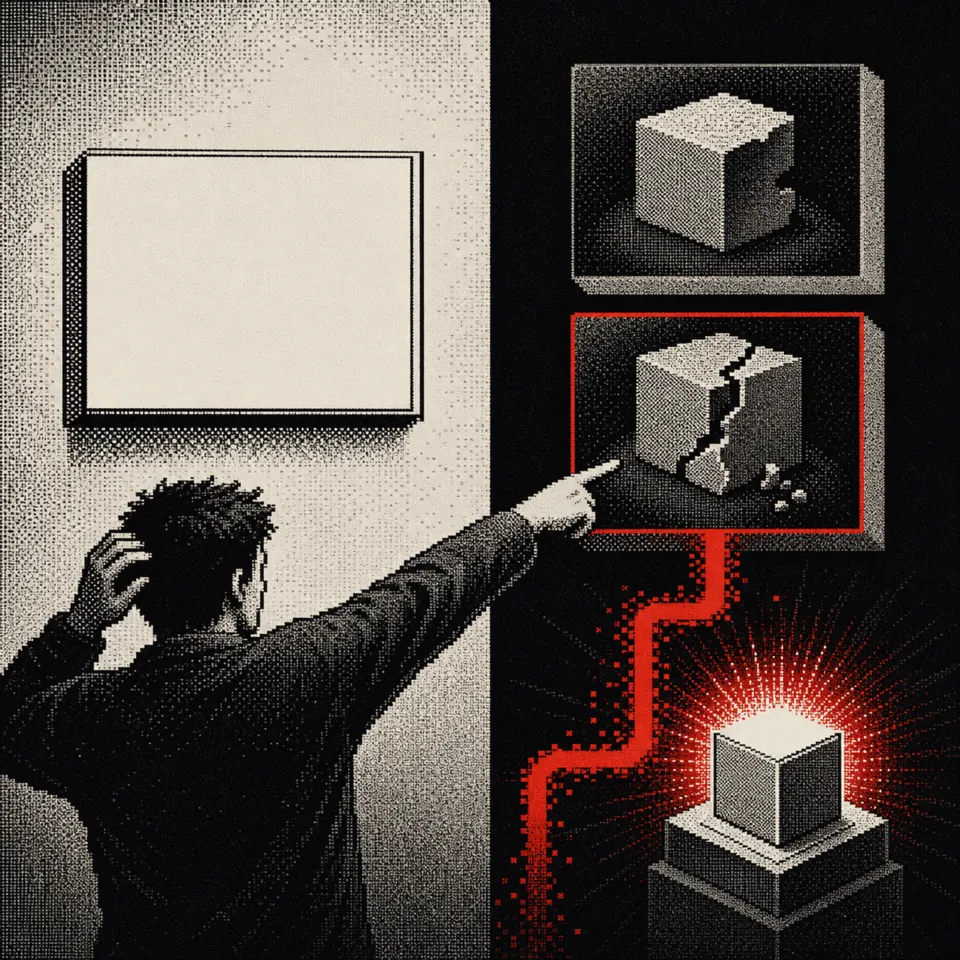
"Describe your brand voice" is recall, and it returns "professional but friendly," which is what everybody returns, which is nothing.
"Here are two lines, A and B, which one is you" is recognition, and it returns an answer in under a second, plus the reason, unrequested, because being wrong in a specific way makes people specific in return.
Same person. Same knowledge. One interface reaches it and one does not.
A correction is worth more than an approval
There is a folk law about this, and like most folk laws it is sharper than the literature. Cunningham's Law: the best way to get the right answer on the internet is not to ask a question, it is to post the wrong answer.
The attribution is a joke nested inside a joke. Ward Cunningham never said it. Steven McGeady coined the line in 2010, in a comment on a newspaper blog, and named it after Cunningham on the strength of some adjacent advice about Usenet from their Tektronix days. Cunningham has since disavowed the whole thing. He never suggested asking questions by posting wrong answers, he says, and he calls it a misquote that disproves itself by propagating across the internet as Cunningham's Law.
He is right that the law is not his. He is also, unwillingly, the best evidence for it. A wrong thing went out into the world with his name on it, and the correction, precise and irritated and sourced, arrived from the one person who could not stand to let it stand. Nobody asked him. He was misquoted, and being misquoted made him articulate.
He also invented the wiki, which is a medium made of nothing except somebody writing something slightly wrong and somebody else being unable to leave it alone.
Measure the two outcomes and it stops being a joke.
An approval is one bit. Yes. It tells you that nothing you had was wrong, which you mostly suspected, and it adds nothing you did not already hold.
A correction is a fact you did not have, delivered in the person's own frame, in their own words, with the emphasis in the place they put it. We don't rush it is not a fix to your copy. It is his differentiator, which he could not have told you, arriving as a side effect of him fixing your copy.
So a draft is not a deliverable. It is an instrument. And this changes what a good draft is.
It has to be specific enough to be wrong in a useful direction. A hedged draft gets a hedged correction, which is to say "looks fine," which is to say nothing. The precision is what makes it fail informatively. You are not trying to be right. You are trying to be wrong at a particular coordinate, so that the direction of the correction carries information.
Probe. Do not poll.
What it costs
Two bills, and I would rather name them than pretend this is free.
A correction is ambiguous. "No, not Friday" might mean Friday is already full. It might mean he hates that photo. Those write two completely different facts and one of them is poison. A correction is only worth as much as its attribution, so when a correction matters and could mean two things, spend exactly one question finding out which. Never two. Two questions and you are back in the blank box, just with extra steps.
Being wrong in public is different from being wrong in private. He said, once, in passing, that he was thinking about adding a truffle pasta. Show him a draft post about the truffle pasta and he says "no, that's still an idea." Post it and he says "take it down, we don't sell that." Same wrongness. Same correction. It always arrives.
The only variable is whether it arrives on a draft or on a live page, and that is the entire difference between a probe and an incident. Be wrong on purpose. Be wrong where it is cheap. The distinction between I intend to and I do is the most important thing anyone will ever tell you, and it is the first thing every system throws away.
Or just go and look
The fourth verb is the one nobody uses, because it costs money instead of costing someone else's attention, and the industry has decided that attention is free.
It is not. His is the scarcest thing in the transaction.
Almost everything in the unknown unknown cell is already sitting in public. His listing. His reviews. The category his competitors chose and he did not. The question a stranger answered on his behalf, wrongly, eight months ago, that he has never seen. None of that requires him to be present, or articulate, or awake. It requires you to spend an afternoon and an API bill.
And when you bring it back to him it does something no question can do. Tell a man a true, checkable, surprising thing about his own business and he does not ask what a category is. He asks how do you know all this. That question is trust igniting, and it only ever comes from the observe cell, because it is the only cell where you show up already holding something.
The tools all skip it. They ask him instead. Asking is cheap for the builder and expensive for the owner, and the bill goes to whoever is not in the room.
The prompt box is a blank box
I have written before that iteration beats the one shot, and that the reason is direction. You cannot correct toward nothing. Models left to introspect with no outside signal do not converge, they drift. Correction needs a target to correct toward.
Look at what that means for the empty box you type into.
The blank prompt is the same object as the blank onboarding form. It demands recall from a human who is better at recognition. It asks him to produce, in one shot, the specification for a thing he will know when he sees and cannot describe before he sees it. And when he types "make it more modern" and gets slop back, we blame him for prompting badly.
He is not prompting badly. He is doing recall on demand, which no one is good at, in an interface with no target to correct toward. Hand him something confidently wrong and he becomes articulate immediately, in the way anyone becomes articulate the moment someone gets them wrong to their face.
The most useful thing you can put in front of a person is not a question. It is a guess, specific enough to be wrong, that they get to destroy.
So
Ask for the one thing that can be asked for, and ask for it once.
Listen for the gaps he names, and store them as questions, never as answers.
Go and look for everything the world already says about him, before you take a minute of his time.
And for the rest, the part that matters, the part he holds and cannot hand you: guess. Out loud. Precisely. Where it is cheap to be wrong.
Then get out of the way and let him correct you, which is the only way he was ever going to tell you.
Sources
- Michael Polanyi, The Tacit Dimension, 1966, ch. 1
- Donald Rumsfeld, US Department of Defense news briefing, February 12, 2002
- Slavoj Žižek, "What Rumsfeld Doesn't Know That He Knows About Abu Ghraib," In These Times, May 21, 2004
- Jakob Nielsen, "10 Usability Heuristics for User Interface Design," 1994, heuristic 6: https://www.nngroup.com/articles/ten-usability-heuristics/
- Lionel Standing, "Learning 10,000 Pictures," Quarterly Journal of Experimental Psychology, 1973
- Cunningham's Law, coined by Steven McGeady in 2010, named for Ward Cunningham, who disavowed it in 2015: https://meta.wikimedia.org/wiki/Cunningham's_Law
- Huang et al. (Google DeepMind), "Large Language Models Cannot Self-Correct Reasoning Yet," 2023: https://arxiv.org/abs/2310.01798
Audio transcript
You are listening to "Be Wrong on Purpose," a note by Jain Yagi.
Imagine asking a restaurant owner what makes the place special.
There is a good chance the first answer is polished and useless. Great food. Good service. A welcoming atmosphere. All true, perhaps, but true of every restaurant that plans to stay open.
Now imagine saying, with confidence, that the restaurant is probably known for cheap lunch specials.
The owner corrects you immediately. No, that is not it at all. The real thing is a family recipe, cooked over a particular fire, served only at dinner. In one correction, the useful answer appears.
That is the strange power of being wrong on purpose. A blank question asks someone to build the answer from nothing. A specific wrong statement gives them something they can recognize, reject, and repair. Correction is often easier than creation.
I started thinking about this through a simple set of actions. You can ask people directly. You can listen to what they already say. You can provoke a response with a claim. Or you can observe what they do. Most forms use only the first action. They present an empty box and quietly hand all the work to the person on the other side.
The blank box looks neutral, but it is demanding. To answer, a person has to understand the question, search memory, decide what matters, compose a response, and judge whether it is worth sending. Silence at the end of that process gets labeled as lack of interest, when it may only mean the route was too expensive.
A wrong draft changes the route. It gives the person a visible shape. They can point to the part that fails. This is the difference between recall and recognition. Creating an answer from memory is hard. Seeing that an offered answer is wrong is fast.
The internet has long known a rough version of this. If you want the right answer, posting the wrong one can attract more corrections than asking a clean question. The important part is not the trick. It is the structure underneath it. People protect distinctions they care about. A bad guess reveals where those distinctions live.
There are boundaries. Ambiguity can produce confusion instead of correction. Being wrong in public can cost trust if it feels manipulative. Private information should not be guessed into the open. The method works best when the claim is clearly a draft, the cost of correction is low, and the person understands that accuracy is the goal.
Sometimes observation is better still. If the answer already exists in what someone has done, asking them to repeat it only creates work. Watch the behavior, read the public evidence, and bring back a concrete interpretation they can refine.
This changes how I see the prompt box too. A prompt box is another blank box. It gives a powerful machine no direction, then asks the user to invent the whole route. A better interface can offer a first shape, show its assumptions, and invite correction.
The lesson is not to be careless with truth. It is to make uncertainty useful. Do the first piece of labor. Put a clear draft on the table. Then let the correction carry both of you closer to what is real.
If you need an answer, do not always ask more politely. Sometimes the fastest path is to guess precisely enough to be corrected.