Note
Kill that neuron
For nine years I gave myself two commands: kill that neuron, build that neuron. It worked, then it broke. The instruction was right and the unit was wrong. You do not change a brain cell by cell. You change it road by road.
For about nine years I ran my life on two commands.
Bad habit I wanted gone? Kill that neuron. New habit I wanted in? Create that neuron. I said it out loud to myself, like flipping a switch. Sleeping late, waking late, some pattern I hated: kill that neuron. Up at six, sitting down to work: create that neuron.
For about four of those years it worked. Then it stopped, and it took me a long time and a lot of falling apart to understand why. The strange thing is that both halves are true at once. The instruction was right. The mistake was in the noun.
Kill I always meant as a metaphor: stop using this, do not route here, let it go quiet. I never thought I was reaching in to destroy a cell. That part was sound. But neuron, singular, one cell, was far too small. The thing I was telling myself to stop using was never a single neuron. It was a whole road.
The count is a decoy
Here is what nobody told me the day I decided to change my brain.
You are losing neurons right now. In the cortex the arithmetic works out to something like 85,000 a day, give or take, roughly one a second, awake or asleep. Nobody sits and counts them ticking off; it is an average pulled from how much the brain thins over a lifetime. Against that, the brain builds maybe a few hundred new cells a day, in one small region tied to memory, and even that number is still argued over in the labs. So the ledger runs at a loss. You end most days with fewer cells than you started.
And nothing happens. You wake up as yourself. At that rate it would take somewhere near 2,700 years to lose one percent of the total. The neuron I was so eager to kill dies on its own, on schedule, by the tens of thousands, and it changes nothing about who I am.
That should have been my first clue. If change were a matter of killing and making cells, change would be the easiest thing in the world. It is not. So the cell was never the unit.
The unit was never the neuron
You carry around 86 billion neurons. You carry, on the order of, 100 trillion connections between them. Sit with that ratio. The cells are counted in billions. The wiring is counted in trillions. That gap tells you exactly where you live.
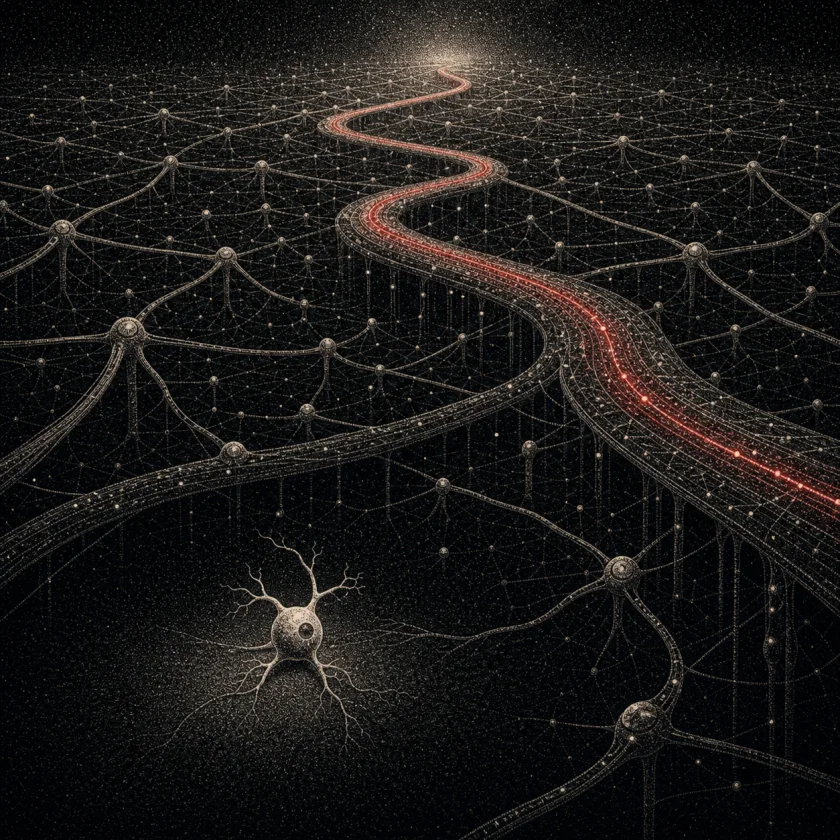
A habit is not a cell. A thought is not a cell. A fear is not a cell. Every one of them is a path between cells, a specific sequence that fires in order, A into B into C, again and again. There is an old line for it: what fires together wires together. And every time it fires, the brain lays a little more insulation on that wire, thickens it, speeds it up. The path gets denser with each repetition, until the signal down it is faster and cheaper than any other route in your head.
Denser and denser, one rep at a time. That is the whole engine, and it runs in both directions. It is how the bad habit got so strong you cannot think your way out of it, and it is the only thing that builds the road that will replace it.
That is what a habit actually is. Not a decision you keep making. A road the brain paved because you kept driving it. The neuron is a node. The road is the software.
Why the old road always wins
So here is the trap I spent years inside.
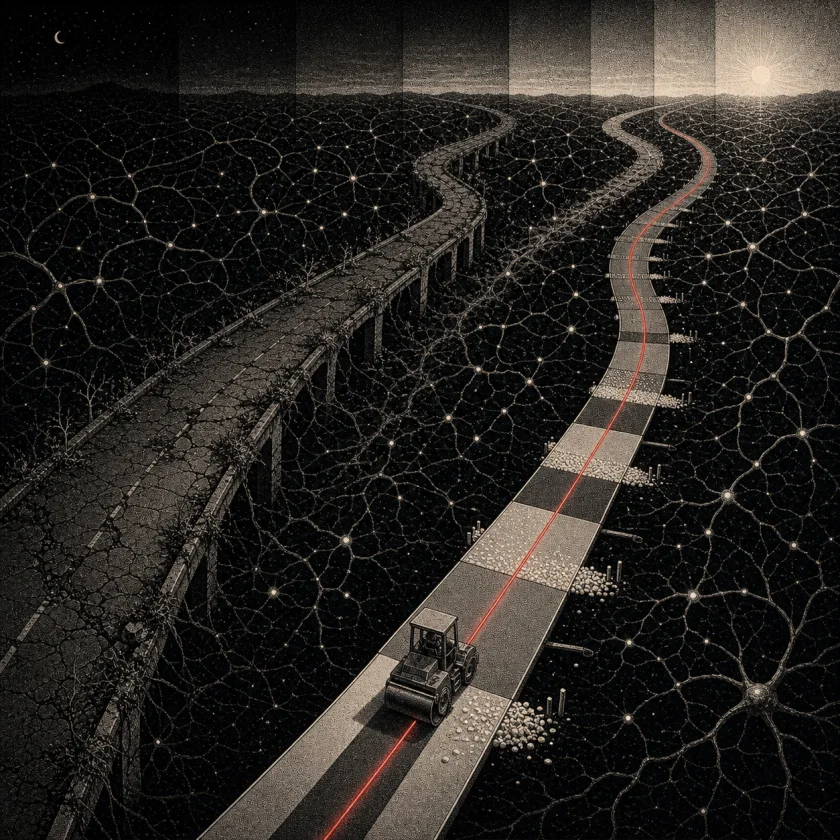
You cannot delete a road. There is no kill switch. The best you can do is stop driving the old one and let it grow over, slowly, while you cut a new one alongside it.
But the new one is a dirt trail. Thin, slow, unpaved. And the old one is a highway you laid down over years. The brain is lazy by design, in the good sense: it routes every signal down the path of least resistance, automatically, without asking you. So the day something knocks you sideways, travel, a bad night, family, stress, a late dinner, your tires find the old groove on their own. You do not choose it. You just arrive there.
For the longest time I read that as weakness. It is not weakness. It is routing. The highway wins because it is the shorter road, and shorter roads win. That is the whole mechanism.
Commitment is a gatekeeper, and he gets tired
Then what is commitment? Not trying harder. I tried harder for years.
Commitment is a gatekeeper you post at the mouth of the old highway. Physically it is the front of your brain firing a signal down to shut the autopilot up: not tonight. And it works, for a while. But that gatekeeper runs on glucose, on sleep, on whatever willpower is left at the end of a day, and he gets tired. Hold the new pattern for a week and you can feel him fading. Then one ordinary Tuesday he is not at his post, and the highway takes the traffic back like you were never gone.
I want to say this part plainly, because I needed to hear it. The collapse is not a moral event. It is a tired gatekeeper. Permanent change is not a stronger gatekeeper. It is the day you no longer need one, because the new road finally became the shorter one and the traffic goes there by itself.
What actually paves a road
You do not beat a habit by attacking it. You beat it with repetition, the same tool that built it. Every rep of the behavior you want lays a little more insulation on the new road and makes it denser. Do it enough and the new road gets denser than the old one, and the brain starts routing there on its own, because now that is the shorter road. The old habit is never defeated in a fight. It is out-built, then left to thin from neglect.
So the only real question is how to pave the new road faster than the old one decays. Three things, and I had none of them named for years.
Repeat it in different rooms. Not just repetition, repetition across contexts. Sleep early at home, in a hotel, after a good day, after a wrecked one. Each version wires a different on-ramp onto the same road, so it can trigger from many starting points instead of one. A road with a single entrance dies the moment that entrance is blocked. A road with twenty entrances survives almost anything.
Give it weight. Connections tied to strong feeling get built faster. Pride, fear, identity, even the sting of breaking a promise to yourself, all of it tells the brain this road matters, prioritize it. Emotion is not the enemy of change. Aimed right, it is the paving crew on a double shift.
Sleep on it. This one is almost a joke, given that the habit I was fighting was sleep itself. At night the brain does its road work. It trims the connections you did not use and reinforces the ones you did. Every good night quietly paves the new road and lets the old one crumble a little more. The thing I was trying to fix was also the tool for fixing it.
Paving is boring, so I run streaks
Here is the part the metaphor hides. Paving is boring. A road does not get denser in a weekend. You have to drive it again the next day, and the next, and the one after that, on the days nothing feels different and no one is watching. Most new roads die right there, in the boredom, long before they are dense enough to win.
So I turn the boredom into a streak.
I pick one thing and commit to a run of it. Two hours on my projects, heads down. Or two hours with my daughter, fully present, no phone in the room. Then I keep the streak alive, day after day, and the streak itself becomes the thing I will not break. Somewhere around four or five weeks with no gap, it quietly changes state. It stops being a streak I am guarding and starts being a road I just drive. The pathway is dense. It holds without me holding it.
Then I start another. And when that one holds, another, and another after that. How soon I stack the next depends on how solid the last one feels. That is the whole method. Not one heroic push, but a chain of streaks, each one paving a road until it can keep itself, then the next.
A streak is really just a trick for staying on the dirt trail long enough for it to turn into a highway. It carries you through the boring middle, the exact stretch where the tired gatekeeper usually quits.
The streak takes no exceptions
There is one reliable way to kill a streak, and it is not laziness. It is a condition. The streak is bed before ten. Then I travel, and a quiet voice offers a deal: I am away, so tonight does not count. That sounds harmless. It is the whole problem. The moment the streak carries an if, bed before ten unless I am traveling, unless there is a dinner, unless the day was hard, it stops being a road that holds everywhere and becomes a road that only exists on the days the condition is false. The brain reads that correctly. It keeps the old shortcut as the real default, the one thing that still runs in every context, and the new pathway thins, trip by trip, until the old highway takes the traffic back.
One honest slip will not undo weeks of driving. A road is not that fragile. What undoes it is the exception that repeats, the if that fires every single trip, because that is just disuse wearing the costume of a good reason. So the streak takes no conditions. Bed before ten, home or hotel, good day or wrecked one. That is the same reason I drive the new road in as many rooms as I can. A road with no exceptions is a road with no off-ramp back to the shortcut.
When the paving crew goes home
I said it worked for four years, then it broke. Here is the honest version.
Some bad investments, some trust placed in the wrong people, and I went down into a stretch of depression where I lost the thread of myself. For a long time I filed that under failure of will. The map I have now is kinder, and I think truer.
In that state the brain makes less of the fertilizer that new connections grow on. It has a name, BDNF, and in depression it tends to run low. So it was not that my will went soft. The construction equipment went offline. And with no crew paving anything new, the old roads, the fear, the withdrawal, the same three thoughts on a loop, ran unopposed, because nothing was being built to compete with them. That is not a character flaw. It is a supply problem. Knowing the difference is most of the way back.
Same driver, better map
So the mantra gets rewritten, not thrown out.
Kill that neuron was never about killing. It was my shorthand for stop using this, let it fall quiet, which is almost exactly what the brain does to a road you stop driving. The instinct was right. Even the mechanism was right. I was pointing attention and will at the thing I wanted to change, and the brain does respond to directed attention. The one thing I had wrong was the scale. I was aiming at a single cell, when the thing I wanted to quiet was a whole highway. Create that neuron had the same flaw and the same fix: not a cell to build, a route to drive until it paves.
The upgrade:
Kill that neuron becomes let that highway decay.Create that neuron becomes pave this new road.
Same driver. Same nine years of proof that the system works. Just a more accurate map of the road.
The gap
There is one more thing, and it is where I am headed next.
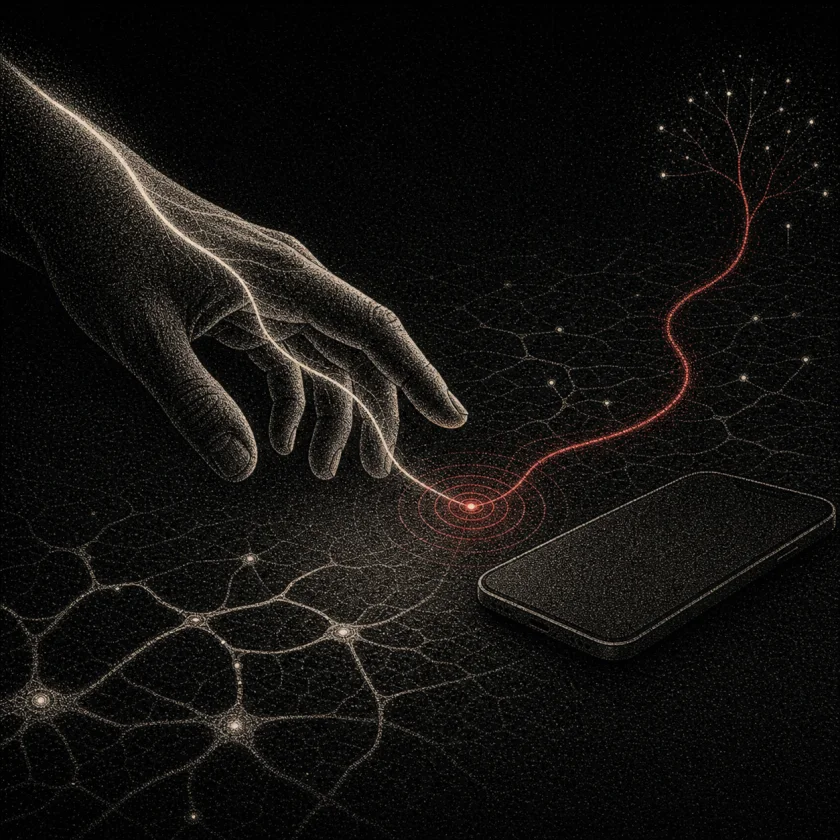
Sometimes I catch it happening. Sitting still, and my hand is already moving toward my phone before I have decided anything. The reach is underway before I'll check it has finished forming. The small miracle is not the reach. It is the catching. Something in me watched the old road try to fire and noticed it in the act.
That noticing is the whole game. It is the gap between the urge and the hand, and everything I have ever changed lived inside that gap. The brain's power to build roads, abandon them, and widen that gap has a name. It is called neuroplasticity, and it is the most hopeful word I know, because it means none of this is fixed.
That is the next road I am paving. I will write it down once I have walked it.
Audio transcript
You are listening to "Kill that neuron," a note by Jain Yagi.
For about nine years, I gave myself two commands.
When I wanted an old habit gone, I said, kill that neuron. When I wanted a new habit to hold, I said, create that neuron. Sleeping late, waking late, reaching for the wrong pattern, kill it. Up at six, sitting down to work, create it.
For four years, the commands worked. Then they stopped. It took a long stretch of falling apart to understand that the instruction was not the problem. The noun was.
I never literally meant destroying a brain cell. Kill was shorthand for stop using this route and let it go quiet. But a habit was never sitting inside one neuron. The brain carries billions of neurons and vastly more connections between them. A thought, a fear, or a repeated behavior lives in the path, not the node.
A habit is a road the brain paved because I kept driving it. Each repetition makes the route faster and cheaper. Over time, what began as a dirt trail becomes a highway. When I am rested and focused, commitment can stand at the entrance and redirect the traffic. But commitment gets tired. A bad night, travel, stress, or an ordinary difficult Tuesday is enough for the tires to find the old groove.
I used to read that return as weakness. Now I read it as routing.
The old road wins because it is still the shorter road. There is no clean delete button. The practical work is to stop feeding the old highway while building another route beside it. The new behavior has to be driven often enough that it eventually becomes the path of least resistance.
That requires more than heroic effort. I need to repeat it in different rooms, after good days and bad ones, at home and away, so the new road has many entrances. I need to give it emotional weight, because the brain pays attention to what feels important. And I need sleep, because sleep is when much of the quiet reinforcement and trimming happens.
The hard part is that paving is boring. Nothing dramatic happens on the twelfth ordinary repetition. Most roads die there, in the middle, before they become dense enough to carry themselves.
So I use streaks. I choose one behavior and protect a run of it. Two hours on my projects. Two hours fully present with my daughter, with no phone in the room. Day after day, the streak carries me across the boring stretch. After four or five weeks, something often changes. The pattern stops feeling like a streak I am guarding and starts feeling like a road I simply drive.
Conditions are dangerous because they preserve the old route as the true default. Bed before ten, unless I travel, unless there is a dinner, unless the day was difficult, is not one road. It is a temporary road with an exit back to the highway. One honest slip does not erase weeks of work. A repeating exception does.
When my own system broke after bad investments, misplaced trust, and depression, I blamed willpower. The kinder and more accurate map is that the construction equipment had gone quiet. Depression can reduce the biological support for forming new connections. Old loops run easily when little new road is being built. That is not a moral failure. It is a supply problem.
So the mantra changes.
Kill that neuron becomes let that highway decay. Create that neuron becomes pave this new road.
Sometimes I catch my hand moving toward my phone before the decision has fully formed. The important event is not the reach. It is the moment I notice the reach in progress. That small gap between urge and action is where a different road can begin.
The hopeful word for all of this is neuroplasticity. It means the map can change. I am still the same driver, but now I know what I am actually paving.