Note
The Component and the Organism
A nineteen-year-old with Jeff Dean's money built a memory layer for AI, open source and well funded, doing the thing I believe in. For one bad second I thought I had been scooped. Then I saw the real shape of it: you can rent a component, but you can only grow an organism, and only one of them is worth more the longer it lives.
I found him the way you find most things now, sideways.
A profile scrolled past. Nineteen years old. Mumbai. Building a memory layer for AI, in the open, MIT-licensed, with a seed round led by people whose names I knew and angels I did not expect. Jeff Dean, who runs Google's AI, put money in. So did the CTO of Cloudflare.
For one honest second, my stomach dropped.
Because memory that spans AI systems, memory you can carry from one to the next, is the thing I have been building. And here was someone younger, funded, already shipping, with some of the most credible people in the field writing him checks.
The first thought was the ugly one. I have been beaten to it.
The second thought was better, and it took the rest of the evening to arrive.
What he actually built
His name is Dhravya Shah. He is nineteen. He grew up in Mumbai and chose Arizona State over sitting for the IIT entrance exam, which, if you know what that exam means to an Indian teenager, is its own kind of nerve. At sixteen he built a small tool that turned tweets into good-looking images and sold it to Hypefury. He holds an O-1 visa, the one the US reserves for people it has decided have extraordinary ability. He interned at Cloudflare and then led developer relations there. This is a serious young man, not a lucky one.
The product is called Supermemory. It began as a hackathon toy in 2024, a way to chat with your own Twitter bookmarks, and it became one of the fastest-growing open-source projects of the year. As I write this it is past 28,000 stars. It swallows the unstructured mess of a life, files, PDFs, web pages, images, audio, and turns it into memory an AI can use. It extracts facts, notices when a new one retires an old one (it knows that "I just moved to SF" cancels "I live in NYC"), resolves the contradictions, forgets what has expired. The seed round was 2.6 million dollars. His own line for what it does is clean: "extract insights from any kind of unstructured data and give the apps more context about users."
I want to be exact about how good this is. It is very good. The customers are real, a desktop assistant, a search product, a real-estate startup, a robotics company. The engineering is real. The founder is the real thing.
Now read his one line again. Give the apps more context about users. That clause is the whole essay.
The component and the organism
Supermemory is a component.
Its customer is a developer, and its job is to sit inside that developer's app and make it smarter about the people using it. It is memory you rent. You call it, it answers, you build on top. It is infrastructure, horizontal by design, and the entire virtue of good infrastructure is that it is the same for everyone who plugs in. The sameness is the feature. It is what lets one endpoint serve a search startup and a robotics company out of the same door.
They ship a personal app now too, one that "remembers everything." But a thing that remembers everything for anyone is still one set of faculties handed to a million people. Generality is the product. It has to be. You cannot sell a thousand developers a memory bent to one particular person, because bent to him it is worthless to the other nine hundred and ninety-nine.
What I am building is not a component. It is an organism.
It is not a part you embed in something larger. It is the something larger. It is one person's nervous system, and it has exactly one user, on purpose. It sees across everything I am building at once, which is where the interesting thing lives, because patterns only surface when a single system watches your whole life instead of a slice of it. It captures the whole stream: links, notes, images, voice, forwarded messages, the receipt, the bank alert. It answers in my own language. It asks me questions in the middle of capture to sharpen its picture of me, then it grades how well it actually understands me. It has a heartbeat, and on its own cadence it notices the people and places and projects it does not yet know enough about, and it goes looking. It routes each thing to the project it belongs to. And it lets my coding agents reach into my own memory over an open protocol.
One of those is a supplier of memory to apps.
The other is a mind.
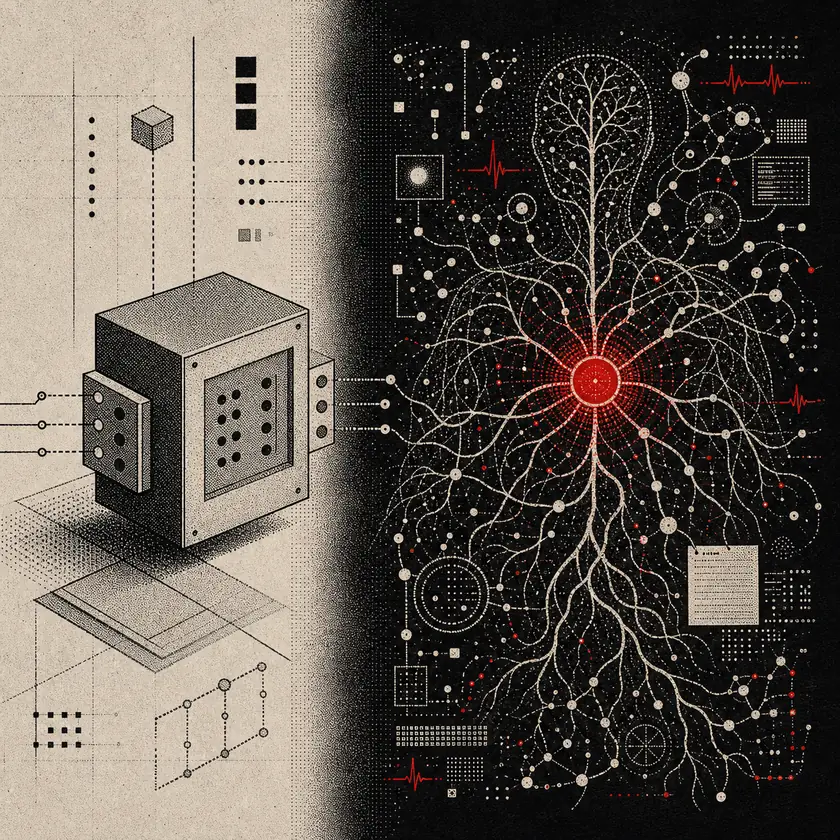
A memory API gives a thousand apps context about their users. A nervous system gives one person a digital mind that compounds. You can build the first on a weekend and sell it to a thousand developers. The second is only ever worth what has accumulated inside it.
A component waits to be called
A component waits to be called. That is not a criticism, it is the definition. An API is a good citizen precisely because it does nothing until asked. It holds no opinion about when to run.
I have written before that a mind should have a heartbeat, that the line between an agent and a function call is a clock and a loop, something that thinks on its own cadence instead of sitting inert until a human pokes it. That same line runs through here. Supermemory is an endpoint. It answers beautifully when addressed. Source runs whether I address it or not.
And it runs with a personality, because it has faculties that take stances. One answers only from what I have actually captured and flatly refuses to guess, because a digital mind that hallucinates is worse than no digital mind at all. A separate one is free to reason about the world in general. One exists only to question me. One grades the answers. An endpoint cannot afford an opinion. A personality is nothing but opinions, held in tension, on purpose.
That is the difference between a thing that remembers and a thing that keeps thinking about what it remembers while you sleep.
What money cannot buy
Here is a place I had it wrong in my own head, and I would rather correct it in public.
When I first saw the funding I guessed high, hundreds of millions. The real number is 2.6 million dollars, and I am glad it is the real number, because the honest argument is stronger than the boast I was about to make.
The boast would have been: less than half their funding, more value. That is unfalsifiable, and small.
The true thing is about the nature of value. Money buys flows. It buys engineering-hours, servers, a larger team, a faster roadmap, all of them things that arrive at a rate you can raise by spending. But some things are not flows, they are stocks, and a stock is the slow deposit of time. You cannot fill a reservoir faster by turning the tap higher for one second. Three years of one person's captured decisions, corrections, and context is a stock. Its filling rate is exactly one life, lived once, in order.
A funded team can rebuild the code of a personal system in a few weeks. Good engineers, good money, it is not hard. What they cannot buy is the state, the per-person understanding that only forms by living alongside a person, accruing at the speed of that person's actual life and no faster, for any price. That is the whole idea of a substrate. The code is cheap. What has settled inside it was never for sale, because it was never sold. It was deposited.
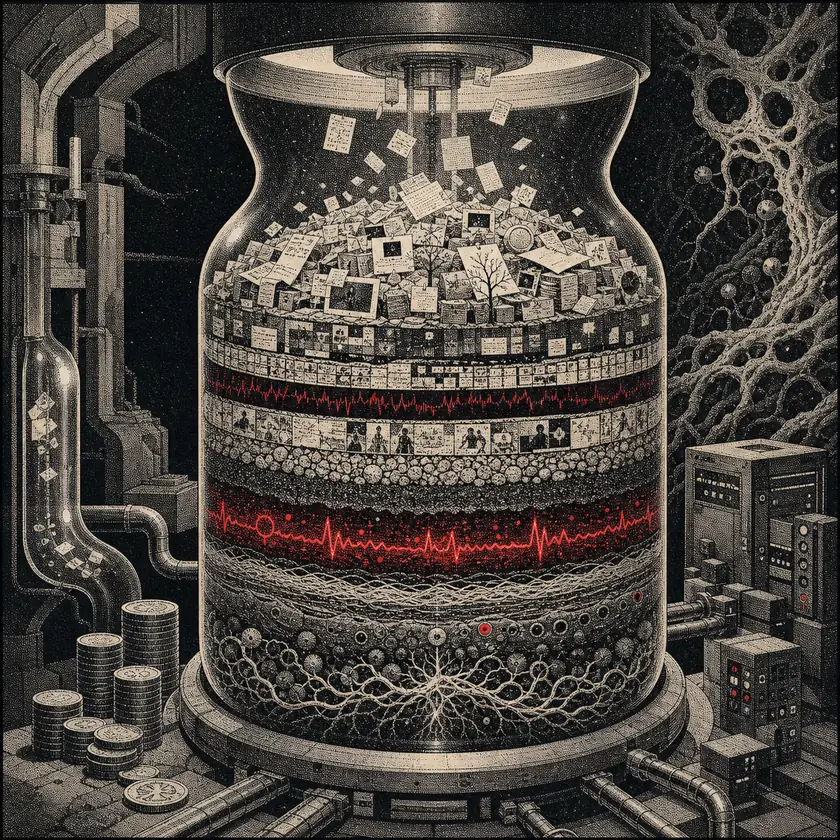
Source runs on about five dollars a month of infrastructure. The real cost is model tokens, not servers, and it serves one founder with a fit no general API can reach, precisely because it refused to be general. Two-point-six million dollars aimed at serving everyone, and pocket change aimed at serving exactly one person completely, are not chasing the same prize. One of them gets cheaper when someone raises a bigger round. The other does not get cheaper for any amount of money, because it is made of time.
Not a fight, a stack
This is the part that surprised me most, and it is the most disarming thing I can tell you.
Because Supermemory is open source and MIT-licensed, and because it already speaks the same open agent protocol my own tools reach for, I could in principle stand on it. Use it as the memory organ inside the larger nervous system. Memory is an organ. An organism is glad to run on an organ it did not have to invent. A rival at one layer can be a supplier at another.
The layers are not even on the same square of the board. He has to win a horizontal market of developers, thousands of them, each renting memory for their own app. I have to do one thing: be the best possible mind for one person, and the memory his own agents reach for first. His is a market. Mine is a fit. Both can be won on the same afternoon, in the same category, without either one taking a thing from the other.
That is not a fight to the death. That is a stack.
Glad to have a rival
So the second thought, the one that took all evening, was this.
A funded, credible, open-source competitor is not a threat to the thesis. It is the loudest possible confirmation of it. It is the market saying, in public, with Jeff Dean's money attached, that memory across AI systems is real and worth building a company on. A lone believer is a crank. A believer with a well-funded neighbor is early.
And the neighbor is a nineteen-year-old who sold his first thing at sixteen and is now building, in the open, for anyone to read, the idea I have staked years on. I went looking for something to be afraid of and came away with something to be glad about. The generous read turned out to be the true one. Good. I am not wrong, and I am not alone.
The part no one can buy
I am not building a better memory API. I am not going to lose a race I am not running.
I am building a digital mind. One that watches everything a single person makes, all of it at once, and grows sharper about that person every day it stays alive. One my coding agents can plug into, so the thing writing my code shares the memory of the person it is writing for. One whose worth does not track anyone's balance sheet, because it is made of accumulated judgment, and judgment is the one asset that does not get cheaper when the money gets bigger.
A component gets better when it is funded. An organism gets better when it lives.
Mine has been living for a while now. That is the part no one can buy, and the part I would never sell.
Sources
- Dhravya Shah on X: https://x.com/DhravyaShah
- Dhravya Shah, personal site: https://dhravya.dev/
- Supermemory: https://supermemory.ai/
- Supermemory, open source (MIT): https://github.com/supermemoryai/supermemory
- "A 19-year-old nabs backing from Google execs for his AI memory startup, Supermemory," TechCrunch, October 6, 2025: https://techcrunch.com/2025/10/06/a-19-year-old-nabs-backing-from-google-execs-for-his-ai-memory-startup-supermemory/
Audio transcript
You are listening to "The Component and the Organism," a note by Jain Yagi.
I found him sideways, in a profile that passed through my feed.
Nineteen years old. From Mumbai. Building memory for AI systems in the open. Backed by people whose names carry real weight, including Jeff Dean and the chief technology officer of Cloudflare.
For one honest second, my stomach dropped.
Memory that can move across intelligent systems is close to the idea I have spent years building. Here was someone younger, funded, already shipping, with credible customers and tens of thousands of people paying attention. My first thought was immediate and ugly: I have been beaten to it.
His name is Dhravya Shah, and the product is Supermemory. It takes files, pages, images, audio, and other unstructured material, then turns them into memory that applications can use. It can extract facts, notice contradictions, and retire old information when a newer fact replaces it. The work is serious, and the founder is serious.
The distinction appeared in one sentence about the product: give apps more context about users.
Supermemory is a component. That is not a dismissal. Good infrastructure should be reusable. A developer calls it, gets memory, and builds something larger on top. Its ability to serve many different applications through the same interface is the feature.
What I am building has a different shape. It is not a memory part waiting to be embedded. It is the larger nervous system around the memory. It is built for one person on purpose. It sees across every project at once. It captures links, notes, images, voice, messages, receipts, and alerts. It asks questions to sharpen its understanding. It grades that understanding. It notices gaps and goes looking on its own cadence. It lets my coding tools reach the memory of the person they are building for.
One system supplies memory to applications. The other tries to become a mind.
The difference becomes clearer when nothing is asking for an answer. A component waits to be called because that is what an API should do. An organism has a heartbeat. It continues to notice, remember, question, and evaluate while no one is pressing a button.
Then there is value. Money can buy engineering time, servers, people, and speed. Those are flows. Personal context is a stock. It accumulates as one life produces decisions, corrections, preferences, and history. A good team can rebuild the code around that state. It cannot purchase three years of lived context and pour it in overnight. The filling rate is one life, lived once.
That was when the fear changed shape. An open component can become an organ inside a larger system. Because Supermemory is open source and speaks a protocol my tools can use, a rival at one layer could become a supplier at another. A horizontal memory business and a personal digital mind are not fighting for the same square. One wins by serving many developers. The other wins by fitting one person completely.
The existence of a credible, funded neighbor does not disprove the thesis. It confirms that memory across intelligent systems matters enough to build a company around. I went looking for a reason to be afraid and found evidence that I was early, not alone.
I am not trying to win a better memory endpoint. I am trying to grow a digital mind whose value comes from accumulated judgment.
A component gets better when it is funded. An organism gets better when it lives.