Note
The Living Toolkit
My first real map of biotechnology: four domains, five tools, and one pipeline (DNA to RNA to protein) that makes the rest of the field legible.
I have always been interested in two ends of biotechnology: agriculture and human gene therapy. Today I did my first proper workout in the field. I was not trying to master it. I wanted a map sturdy enough to hang everything else on.
The map starts with one idea.
Biotechnology is the use of living systems and their machinery (cells, enzymes, DNA, and whole organisms) as tools for making useful things.
Brewing beer with yeast is biotechnology. Engineering bacteria to produce human insulin is biotechnology too. The idea did not change between them. What changed was how precisely we could direct the biology.
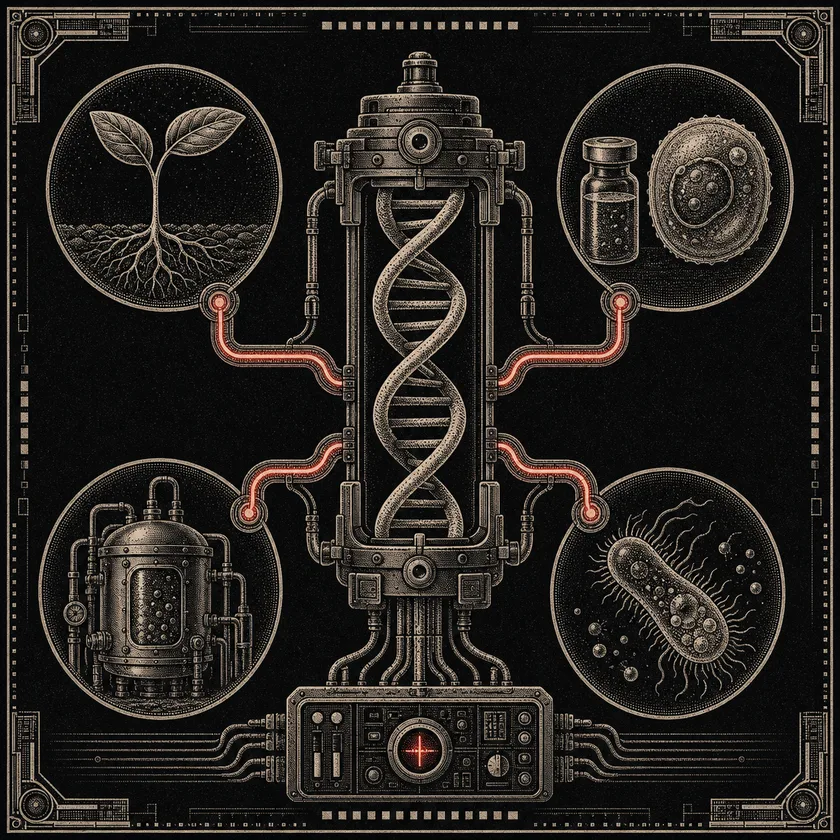
Four colors, four domains
A common introductory map divides the field by color:
- Red biotechnology is medical: drugs, vaccines, diagnostics, and gene therapy.
- Green biotechnology is agricultural: pest resistance, drought tolerance, and better crops.
- White biotechnology is industrial: enzymes in detergents, biofuels, and bioplastics.
- Blue biotechnology works with marine and aquatic organisms.
The colors are only labels. The biology underneath them overlaps. A method developed for one domain can become the missing tool in another.
Five tools underneath the field
Most of modern biotechnology rests on a small core toolkit.
Recombinant DNA cuts and combines genetic material, including genes from different organisms. This was the breakthrough in the 1970s that opened modern biotechnology.
PCR copies a chosen stretch of DNA millions of times. A sequence that was too scarce to study becomes abundant enough to detect and work with.
Sequencing reads the order of bases in DNA. Before biology can be deliberately changed, it first has to be made legible.
CRISPR edits DNA at a targeted location. Compared with earlier gene-editing tools, it made precise experiments dramatically easier and cheaper.
Cell culture and fermentation grow cells at useful scale. Once the instructions are right, the cells become tiny factories that manufacture the product.
The pipeline that makes it click
The first mental model worth keeping is:
DNA → RNA → protein
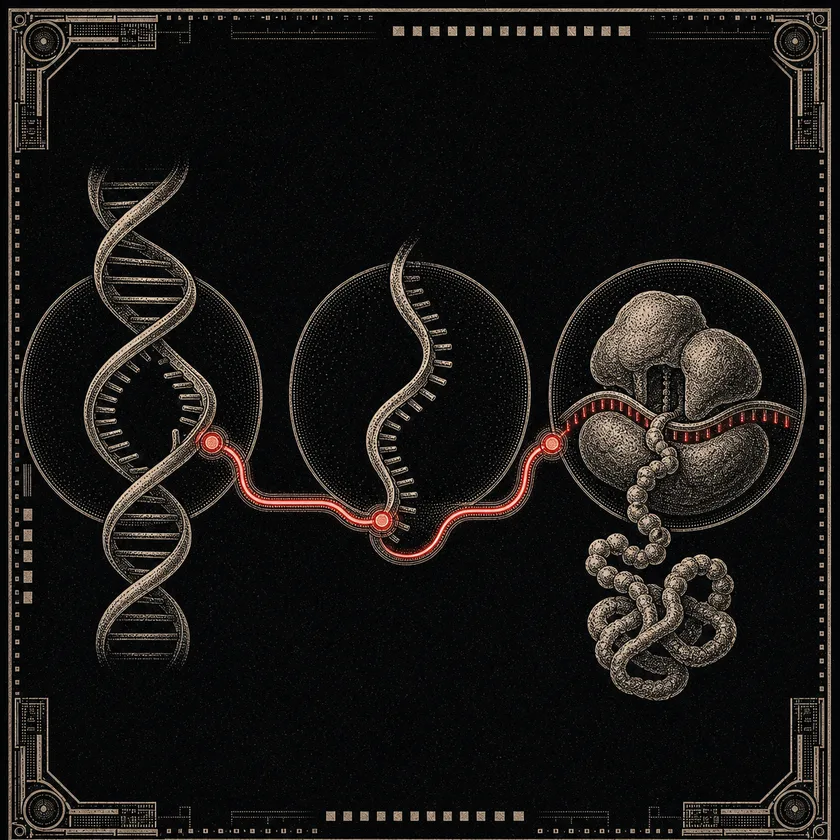
DNA stores instructions. RNA carries and interprets them. Proteins do most of the work inside a living system.
That model is deliberately simple, but it gives me a way to read almost any biotech technique. Sequencing reads the instructions. PCR copies a selected passage. Recombinant DNA and CRISPR change the instructions. Cell culture runs them at scale. The field keeps returning to the same flow: read it, copy it, edit it, or redirect it toward something useful.
That is enough for a first day. I do not need to memorize every headline yet. I need to follow the flow.
My two strongest pulls, agriculture and human gene therapy, sit in different color-coded domains, but they share this same machinery underneath. So the place to begin is not by choosing between them. It is molecular biology: learn the common language first, then follow it into the field and the clinic.
Audio transcript
You are listening to "The Living Toolkit," a note by Jain Yagi.
For a long time, biotechnology looked to me like two separate doors.
Behind one door was agriculture: crops, soil, food, and the old problem of helping living things survive difficult conditions. Behind the other was gene therapy: cells, disease, and the possibility of repairing something deep inside a body. I was interested in both, but I did not yet have the map that showed they belonged to the same building.
The map begins with a simple idea. Biotechnology is what happens when we use living systems, or parts of them, to make something useful. Human beings were doing that before anyone could see a cell. Bread rises because yeast does work for us. Fermentation changes food because microbes run chemistry we learned to guide. The modern field did not replace that ancient relationship. It gave us finer tools for directing it.
People divide biotechnology into colors. Red is medicine. Green is agriculture. White is industrial production. Blue is the biology of oceans and aquatic life. The colors help you see the applications, but the machinery underneath them keeps repeating.
The same small toolkit appears everywhere. Recombinant DNA lets us move useful genetic instructions. PCR gives us enough copies of a chosen stretch of DNA to study. Sequencing lets us read the order of those instructions. CRISPR gives us a way to edit at a precise location. Cell culture and fermentation let living systems carry out the work at scale.
Once I saw the repetition, the field stopped looking like a wall of unrelated inventions. It became an assembly line. DNA stores an instruction. RNA carries a working copy. Protein performs the action. Change the instruction, change when it is copied, or change how the protein behaves, and you can alter the outcome.
That logic can lead to a treatment that helps a patient, a crop that handles stress, a microbe that produces a material, or a process that cleans something we have polluted. Different door, same living machinery.
It also changed how I think about learning the field. I do not need to begin by choosing between agriculture and medicine as if one interest cancels the other. I need to learn the common language first: molecular biology, cells, inheritance, proteins, and the tools that let us observe and intervene. Specialization makes more sense after the shared foundation is visible.
The most useful discovery was not one technique. It was the fact that the map is connected. Start with the flow from DNA to RNA to protein, then follow what happens when people learn to read it, copy it, edit it, and grow it. The doors stop competing. They open onto the same living toolkit.