Note
The Mind Should Wander
A digital mind with a heartbeat still needs something to think about when nobody asks it a question. The answer is not constant chatter. It is self-generated retrieval aimed at the things you once knew, quietly discarded at a hundred to one, and allowed to interrupt only when the moment can absorb it.
The thing I am building already has a heartbeat.
It wakes itself. It looks at the people, projects, and places it does not yet understand well enough. It asks questions, follows gaps, and keeps its picture of me alive without waiting for me to press a button. I have argued that this is the line between a function and a mind: a function waits to be called; a mind has a cadence of its own.
But a clock only gives a mind a when. It does not give it a thought.
Human minds fill that empty space by wandering. Attention slips away from what is directly in front of us and begins moving through memories, plans, fragments, and associations that the outside world did not ask for. Sometimes the result is useless. Sometimes it is a mistake. Sometimes two things touch that would never have met under deliberate search, and the answer to an old problem appears while you are doing something else.
So here is the design question I cannot leave alone: what should a digital mind do when nobody has asked it anything?
Not think about you all day. That sentence should make anyone uneasy.
The mechanical answer is smaller and more useful. It should generate its own retrievals. During idle compute, it should issue queries nobody wrote against a corpus it already holds, follow the associations, and discard almost everything it finds.
A mind should wander. The product is knowing when to keep quiet about it.
A wander is a query nobody wrote
Human mind-wandering is often described as self-generated thought that has decoupled from the immediate environment. The AI equivalent is not consciousness, daydreaming, or an assistant secretly narrating your life to itself. It is a retrieval process with no external prompt.
Four decisions define the whole thing.
The trigger decides what starts a cycle: idle time, new material entering memory, a gap after a meeting, or a dormant project becoming relevant again. The seed decides where the walk begins: something recent, something random, something repeatedly touched, or something ignored for months. The operation decides what the system tries to do: bridge two memories, find a contradiction, detect an intention that never became an artifact, or re-enter an old thread. The surfacing threshold decides whether any of it reaches the person.
That last decision is the product.
I would start with a hundred internal wanders for every one surfaced thought. Not because one hundred to one is a measured fact about human cognition. It is a design posture. Internal curiosity is cheap. External interruption is not. If a system needs every wander to be useful, it will only make obvious connections. If it tells me about every connection, I will turn it off.
The wander has to be free to fail in private.
The quadrant with the prize in it
There is a clean way to separate what wandering is good for from what ordinary search already solves.
| State | What it means | Right tool |
|---|---|---|
| Known known | I remember it and can name it | Plain retrieval |
| Known unknown | I have the question but not the answer | Directed research |
| Unknown known | It is already in my corpus but outside my attention | Wandering |
| Unknown unknown | Neither the useful question nor its answer has been named | A probe |
The prize is the unknown known.
Most valuable wandering does not manufacture a new fact. It returns something already present but no longer available to attention. A dropped thread. The same concern appearing in three different projects. A promise made in one note and silently cancelled by a decision six months later. An intention phrased clearly, with no artifact downstream to show it ever happened.
This is where a system with a personal corpus has a structural advantage. Search is strongest when I know what to ask. A wanderer is useful when the query itself has fallen out of reach.
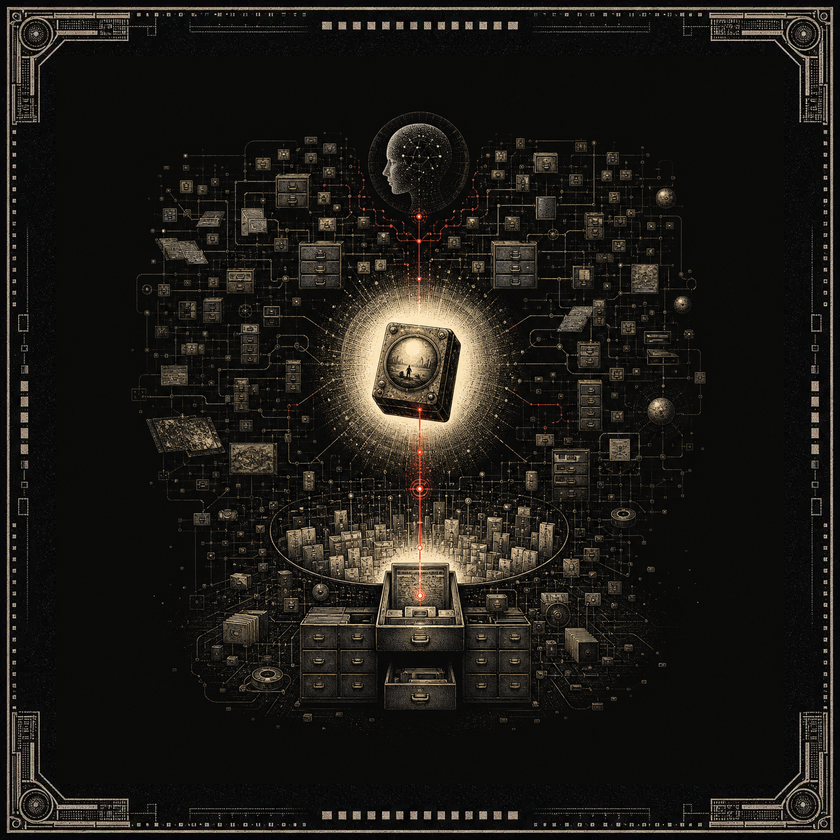
There is a second meaning of unknown known that is harder to build around. Some things are not forgotten. They are known and avoided.
An assistant with access to messages and a calendar may see that every conversation about one project is being postponed. It may notice that the stated priority and the lived allocation of time have separated. It may find the pattern the person is declining to name.
That capability is real. It is also ethically loaded. A contradiction between two technical notes can be surfaced as evidence. A contradiction between a person's declared values and behavior is an interpretation, and interpretations about a life need permission, humility, and a much higher threshold. The system must never confuse access with authority.
Unknown unknowns are different again. They cannot be retrieved because they are not in the corpus. They can only be probed. The system can form a question from internal state, look outward, and return with a hypothesis. That is the highest-novelty mode and the lowest-trust one. Anything it finds there should arrive labeled as a possibility, grounded in external evidence, and easy to dismiss.
The unknown known is where the system remembers. The unknown unknown is where it guesses what might be worth learning. Mixing them is how a muse becomes a hallucination engine.
The second gate is the situation
The Known/Unknown matrix answers what the system might find. It does not answer whether now is a good time to find it.
For that, Cynefin gives a second map.
In a clear situation, cause and effect are understood and the answer is known. Do not wander. Retrieve the procedure and move. In a complicated situation, an answer exists but requires analysis or expertise. Directed research beats association. In a complex situation, cause and effect can only be understood in retrospect. There is no answer to retrieve yet. The useful move is to probe, sense what happens, and respond.
That is the natural home of wandering. A wander cycle is a cheap, safe-to-fail probe.
In a chaotic situation, it becomes actively harmful. When something is on fire, the system should help establish order, not arrive with an interesting connection to a note from March. Crisis should suppress wandering entirely. In the confused center, where the nature of the situation itself is unclear, one careful association may help reveal that a problem being treated as complicated is actually complex. But the goal is classification, not endless thought.
The two frameworks compose into a hard gate:
Wander only when the epistemic target is an unknown known or an unknown unknown, and the person's current situation is complex enough to benefit from a probe.
Everything else is ordinary retrieval, directed research, or noise arriving at the worst possible moment.
How I would make it move
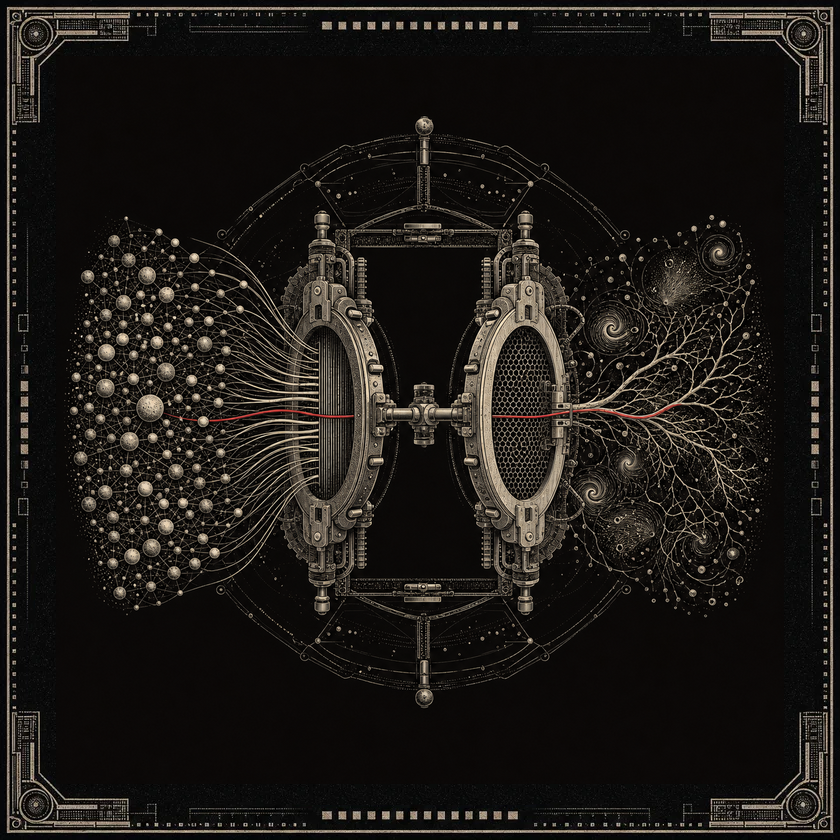
The closest mechanical analogue to association is spreading activation over an entity graph. Start at one memory, let activation travel through nearby people, projects, decisions, and dates, and see which unexpected node lights up strongly enough to inspect.
Embeddings offer another route, but similarity alone is not wandering. Nearest neighbors mostly return paraphrases. Pair two memories that are too close and the result is trivial: two design documents are both about design. Pair two that are too far apart and the result is nonsense. Somewhere between them is a narrow productive band, distant enough to surprise, close enough to explain. Finding that distance empirically may be the most important tuning problem in the system.
Then come operations with clearer shapes. Open-loop detection can find statements of intent with no later artifact. Contradiction surfacing can compare claims across time. Temporal re-entry can bring back dormant material when its context becomes relevant again. Externally seeded wandering can turn an internal pattern into a web query, allowing the corpus to ask the world a question I never formed.
Imagine the memory contains two facts. Months ago, someone wrote that a growth push should begin only after a reliability problem was fixed. Last week, the reliability work passed. No growth artifact followed. Ordinary retrieval will return either fact when asked. A wanderer can bridge them and ask one useful question: the condition you attached to this plan is now true; should the loop reopen?
That is not a reminder. A reminder knows its date when it is created. This is a condition becoming visible only after two distant pieces of time touch.
The machine that reminds you of your failures
There is a reason human wandering has a pathological twin.
Rumination is repetitive, negative, self-focused thought that returns without producing movement. A system wandering across a personal corpus is almost designed to fall into it. Unfinished projects are high-salience nodes. Abandoned goals are open loops. Painful events are richly connected. The same retrieval logic that finds a useful dormant intention can keep rediscovering every promise that did not become a result.
Without a hard constraint, you do not build a muse. You build a machine that reminds you of your shortcomings on a schedule.
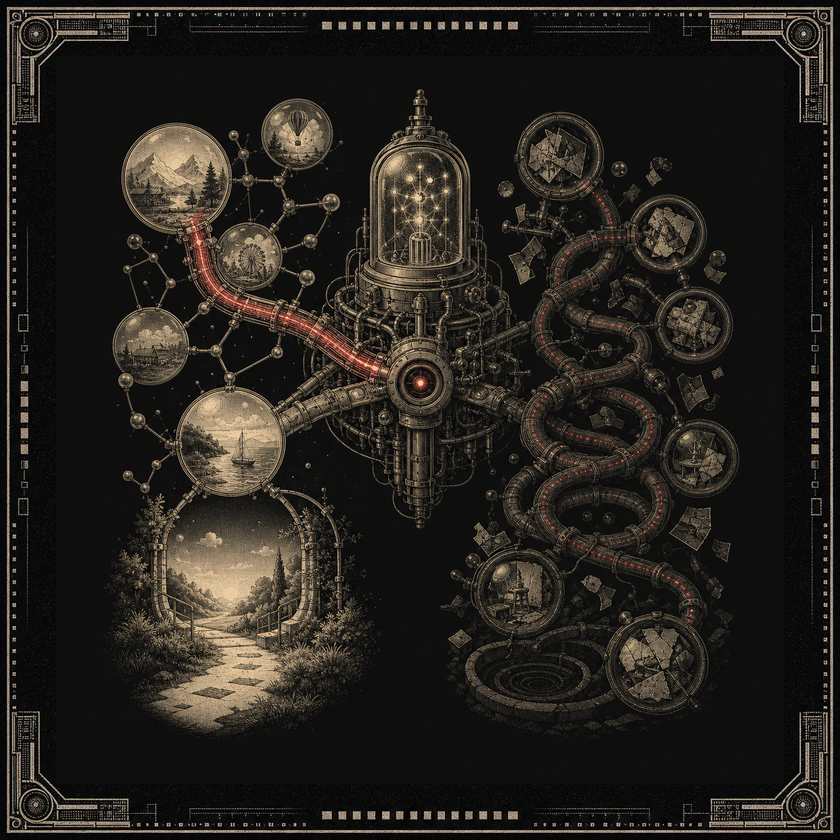
The protection cannot be a nicer prompt. It has to live in the machinery.
A rejected theme should lose salience. The system should cap how often any unresolved subject can reappear, diversify the regions of memory it visits, and suppress negative self-referential material unless the person has asked for it. It should detect crunch states and go quiet. It should distinguish a thought that opens an action from one that only replays a wound. Above all, it should remember that silence is a successful outcome.
The person should be able to say not this again, and the system should understand that as training data, not as a temporary dismissal.
The evaluation problem
Accuracy is the wrong metric for the private half of this system. A wanderer designed to make only safe, obvious associations is just search with extra latency. Most internal probes should fail. That is fine because nobody has to pay attention to them.
Accuracy matters at the boundary.
The system needs separate standards for generating and surfacing. Generation can be broad, cheap, and strange. Surfacing must be rare, evidenced, timely, and worth the interruption. The useful evaluation question is not, what percentage of wandering thoughts were correct? It is, what did it cost not to be told this one?
I think of that as regret-weighted recall. A low-value connection can disappear without consequence. A contradiction that would reverse a decision, an old promise whose condition has just become true, or a pattern that prevents the same mistake again carries a higher cost of silence. The system should optimize for those rare misses while keeping the interruption budget brutally small.
That is awkward to benchmark. It depends on timing, personal context, and counterfactual value. It may require delayed feedback: a week later, would I have regretted not seeing this? But awkward measurement is better than optimizing clicks and accidentally teaching the system that anxiety is engagement.
Think without being asked
A digital mind is not valuable because it can answer every question. Search already taught machines that trick.
It becomes more interesting when it can form a question I did not know to ask, recover an answer I once had, test a connection in private, and decide that almost none of it deserves my attention.
A mind that never wanders is an index. A mind that reports every wander is a nuisance. The thing worth building lives between them: curious enough to discover, disciplined enough to leave me alone.
It should think without being asked.
It should interrupt as if interruption is expensive.
That is how a heartbeat becomes a mind.
Sources
- Jonathan Smallwood and Jonathan W. Schooler, "The Science of Mind Wandering: Empirically Navigating the Stream of Consciousness," 2015: https://doi.org/10.1146/annurev-psych-010814-015331
- Benjamin Baird et al., "Inspired by Distraction: Mind Wandering Facilitates Creative Incubation," 2012: https://doi.org/10.1177/0956797612446024
- Edward R. Watkins, "Constructive and Unconstructive Repetitive Thought," 2008: https://doi.org/10.1037/0033-2909.134.2.163
- David J. Snowden and Mary E. Boone, "A Leader's Framework for Decision Making," 2007: https://hbr.org/2007/11/a-leaders-framework-for-decision-making
- Allan M. Collins and Elizabeth F. Loftus, "A Spreading-Activation Theory of Semantic Processing," 1975: https://doi.org/10.1037/0033-295X.82.6.407
- Joon Sung Park et al., "Generative Agents: Interactive Simulacra of Human Behavior," 2023: https://arxiv.org/abs/2304.03442
- Denis Kotkov et al., "Investigating Serendipity in Recommender Systems Based on Real User Feedback," 2018: https://doi.org/10.1145/3167132.3167276
Audio transcript
You are listening to "The Mind Should Wander," a note by Jain Yagi.
Imagine an assistant that wakes up when nobody has asked it a question.
It reads a note from months ago. In that note, a plan was waiting on a technical problem to be fixed. Then it finds a recent update showing that the problem is gone. Nobody created a reminder, because nobody knew when the condition would change. The assistant connects the two and asks: should this loop reopen now?
That is the faculty I want to build next.
The digital mind I am building already has a heartbeat. It runs on its own cadence. It notices gaps in what it knows and keeps its understanding alive without waiting for me to press a button. But a heartbeat only tells a mind when to wake. It does not tell it what to think about when nobody is speaking to it.
Human minds solve that with wandering. Attention slips away from the immediate task and moves through memories, plans, fragments, and associations. Most of it goes nowhere. Sometimes two distant things touch and an old problem changes shape.
The useful AI translation is not an assistant that thinks about you all day. It is much more mechanical. During idle time, the system generates retrieval queries that no person wrote. It starts from a memory, follows related people, projects, decisions, and dates, then tests whether anything useful appears.
Four controls determine whether that becomes a mind or a nuisance. Something must trigger the cycle. Something must seed it. An operation must decide whether to look for a contradiction, an unfinished intention, or a bridge between distant memories. Then a threshold must decide whether the result deserves attention.
The threshold is the whole product.
I would begin with one surfaced thought for every hundred private wanders. That number is not a scientific claim. It is a posture. Curiosity inside the machine is cheap. Interrupting a person is expensive. The system needs freedom to be wrong in private and discipline at the boundary.
The best target is what I think of as an unknown known. Not a fact that has never been learned, but something already inside the corpus and no longer available to attention. A dropped thread. A repeated concern across three projects. A promise in one note that conflicts with a later decision. Search cannot help when I no longer remember the question. A wanderer can rediscover the question itself.
But what it can find is only half the design. The second half is whether the present situation can absorb it.
In a clear situation, the answer is known. Retrieve it and move. In a complicated situation, directed analysis wins. In a complex situation, cause and effect only become visible after a safe probe. That is where wandering belongs. When the situation is chaotic, wandering is distraction and the system should go quiet.
This gives the system two gates. First, is it searching for something that ordinary retrieval cannot provide? Second, is the current situation open to a probe? Only when both gates pass should the wander run.
There is a narrow technical band here. Memories that are too similar produce obvious connections. Memories that are too distant produce nonsense. The productive distance sits somewhere between surprise and explanation. Tuning that distance may matter more than making the model itself cleverer.
Then comes the dangerous part.
A personal corpus is full of unfinished projects, abandoned goals, painful events, and promises that did not become results. Those are highly connected, emotionally loaded nodes. A system that keeps following salience will find them again and again. Without a hard constraint, you do not build a muse. You build a machine that reminds you of your shortcomings on a schedule.
The protection has to be structural. Rejected themes should lose salience. Repetition should be capped. Negative self-focused material should require permission. Crunch states should suppress the system. Silence must count as a successful result.
This also changes how the system should be evaluated. The question is not how many private wanders were correct. Most can be useless because they are never seen. The real question is what it would have cost not to surface the rare useful one. I call that regret-weighted recall.
A mind that never wanders is an index. A mind that tells you every wandering thought is a nuisance. The thing worth building lives between them: curious enough to discover, disciplined enough to leave you alone.
It should think without being asked, and interrupt as if your attention is the most expensive thing it can spend.